Know what will actually move the number, before you spend on it.
AnantCausal is a causal AI decision intelligence platform. Describe how your business works in plain English and get a causal model you can read, a straight answer on whether your question can be answered, and a record of every decision.
Bring one real decision. We will run it live in the walkthrough.
1 · The model it built
2 · What it tells you
Effect of training on defects
Identified by adjusting for Shift. Source of every probability shown.
Effect of line speed on defects
An open path nothing you measure can block. You get the reason, not a number.
- Every probability shows its source
- Says so when a question can't be answered
- Hands models to DoWhy, EconML and CausalML
- Runs on your own hardware
Whatever your role, the question is the same: what should we change?
Operations and performance
Three teams, three theories, one budget.
Stop funding pilots that were never going to move the metric.
See howRisk, audit and compliance
“Why did we do that?” arrives months later.
Reconstruct what a decision rested on in minutes, not weeks.
See howData science and AI leaders
Models produce numbers nobody can source.
Give every number an origin and every answer a status.
See how
Dashboards tell you what happened. They can't tell you what to change.
Two metrics move together and the meeting turns into an argument about why. The causal story lives in a workshop, a slide or somebody's head, so the budget follows the loudest theory.
Correlation looks like an answer
A spreadsheet flattens a causal chain into two columns that happen to move together.
Assumptions go unwritten
The reasoning behind a decision is rarely captured, so nobody can review it later.
Spend follows opinion
Without a way to compare options on the same model, the strongest voice wins.
AnantCausal makes the causal model an artifact your team can review, challenge and reuse.
Three reasons teams choose a causal model over another dashboard.
Spend on what works
Find the lever that actually moves the outcome, and stop funding interventions that were never going to. The model separates a real cause from a number that merely moves with it.
Defend every decision
Each probability shows its source and each decision is kept beside the analysis it rested on, so “why did we do that?” has an answer a reviewer can check.
Decide before you can test
Experiments are slow, costly and sometimes impossible. A causal what-if analysis gives you a reasoned answer first, and shows which interventions deserve a test.
The same decision, two ways.
Without a causal model
- Reasoning lives in a slide or somebody's head
- A correlation stands in for a cause
- One number, no sense of how wrong it could be
- Nothing to show an auditor later
With AnantCausal
- The causal story is written down and reviewable
- The tool says if the question can't be answered yet
- An answer with its range and assumptions stated
- A decision record linked to the analysis
From a business question to a decision you can defend.
Describe, model, test, decide, record. You can stop at any stage and keep the value.
Step 1
Describe
Plain English, a document, a table or a query
Step 2
Model
A causal graph with every probability sourced
Step 3
Test
Is the question answerable? Can the answer be broken?
Step 4
Decide
Compare options, with the range stated
Step 5
Record
The decision, kept beside its analysis
See an answer, with its working shown.
This is the AnantCausal console on a health-plan scenario: does completing prior authorization reduce claim denials? The verdict, the source of every number and the assumptions are on the screen, not behind it.
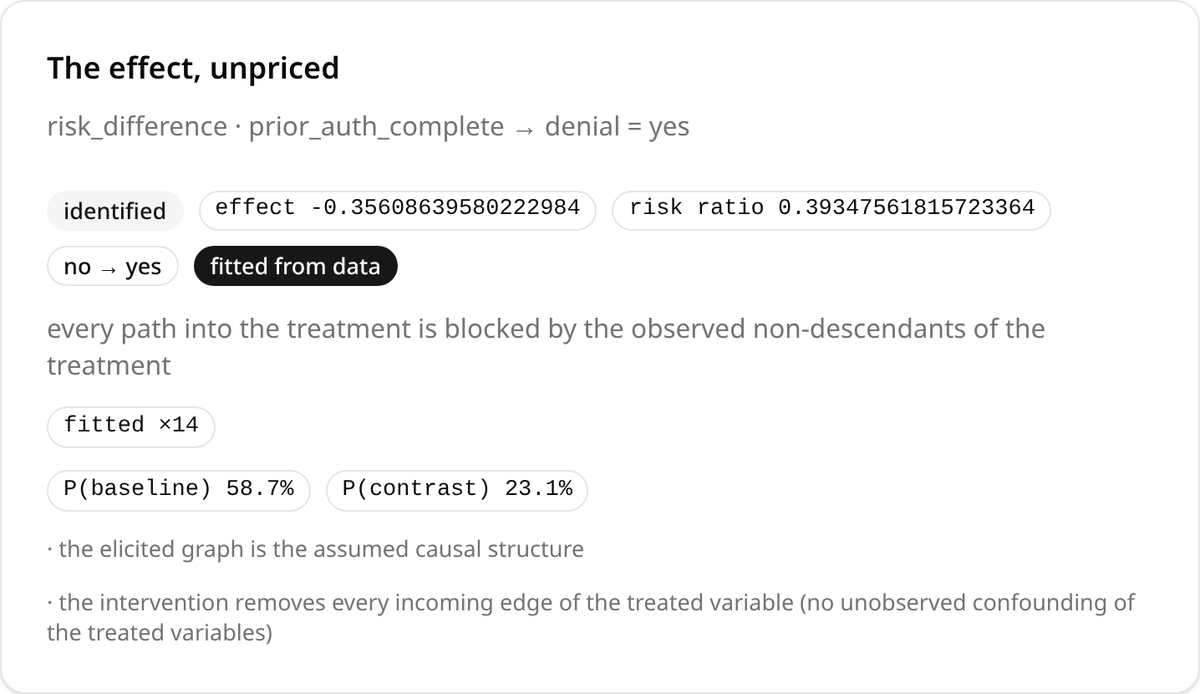
A verdict first
“Identified” means the question can be answered from this model, and the reason is stated.
Sources on every number
“Fitted from data” tells you these probabilities were computed from counts, not guessed.
Assumptions in plain view
What the answer rests on is listed beneath it, ready to be challenged.
- See the full health-plan example
When it can't answer, it tells you. It never guesses.
Most tools always return a number. AnantCausal returns a number only when the model supports one, and otherwise tells you exactly what is missing. Each of these is a result, not an error.
- Not identified
The question can't be answered from this model
You get the reason and what would unblock it, instead of a number with a footnote.
Fix the model, not the data.
- Missing value
An outcome has no price
Unpriced outcomes are refused, not treated as zero, so a gap can't quietly tilt a recommendation.
Complete the values, then rank the options.
- Inconclusive
A stress test didn't finish
It is reported as inconclusive and never counted as a pass.
Rerun with more detail, or note the gap.
- Tied
Two options are level
A tie is reported as a tie. No option is dressed up as the winner.
Buy more information, or pick on other grounds.
See when “probably helps” turns into “can't tell”.
The most useful thing a causal model reports is how far its answer moves if your assumptions are wrong. Drag the slider and watch the decision change.
1 · Pick an action
Batches with a defect
8.8%
From the manufacturing example. Synthetic data.
2 · How wrong could your assumptions be?
Effect of training on defect rate
-21.7 to -12.1 points
Training helps across the whole range. The decision holds even if your assumptions are off.
A toy model for illustration. The point estimate is from the manufacturing example; the slider widens an invented range to show how a result changes when it crosses zero. It is not AnantCausal output.
Everything between the question and the record.
Identification
Find out up front whether your question can be answered, and what blocks it if not.
Learn moreProvenance
Every probability is tagged: elicited, expert-entered, fitted from data or mixed.
Learn moreRefutation
Three checks that can fail, plus a fragility measure, so surviving means something.
Learn moreDecision record
What was approved, by whom, what happened, and how it compared with the claim.
Learn moreInteroperability
Hand the model to DoWhy, EconML or CausalML with its assumptions attached.
Learn morePrivate by design
Runs on your hardware, with a local model if you prefer. Questions never have to leave.
Learn more
Start with a decision your team already faces.
The step before estimation, and the record after it.
Dashboards show what happened. Estimation libraries measure an effect once you have a causal graph. AnantCausal builds and tests that graph, then records the decision.
Dashboards & BI
Show what happened
- Trends and correlations
- No causal structure
- Decisions live elsewhere
Estimation libraries
Measure an effect from data
- Need a graph you already have
- Estimate from observed samples
- Analysis, not a decision trail
AnantCausal
Build, test and record
- Builds the graph from plain English
- Says whether the question is answerable
- Keeps the decision with its evidence
Third-party tools are named factually. No partnership or endorsement is implied.
Published limits, not vague promises.
- Model size
- Up to 24 variables
- Query speed
- p50 75 ms · p95 272 ms
- Concurrency
- 25 queries, 0 errors
- Tenancy
- Per-project isolation
Latency figures are development-machine measurements, not production guarantees. See the capacity page for the full envelope and conditions.
What is a better-informed decision worth to you?
Enter your decisions, your spend and your own assumptions. The calculator shows the arithmetic, with no forecast hidden inside, so you can see how much of your budget rests on a judgment nobody has written down.
Start with one decision, not a platform rollout.
- 1
Bring a decision
A walkthrough on a real decision your team faces. We model it live and show you what it can and can't answer.
- 2
Model it together
Turn your knowledge into a reviewable model and compare your options, with the assumptions on the table.
- 3
Decide how to grow
If it earns its place, extend to the next decisions. If it isn't a fit, we will say so.
Self-hosted and licensed around the decisions in scope. No per-query metering, and no extra charge for the record.
Plain-English guides to causal AI and decision intelligence.
- Comparison
Causal AI vs predictive AI vs A/B testing: which one answers your question?
Predictive AI tells you what is likely to happen, an A/B test measures what happened when you changed something, and causal AI works out what would happen if you did, before you spend.
6 min read - Guide
What-if analysis for business decisions: beyond the spreadsheet scenario
A what-if analysis is only as good as the relationships behind it, and most spreadsheet scenarios assume those relationships instead of modeling them.
5 min read - Free checklist
The causal decision checklist: ten questions before you fund an intervention
Ten questions that take a team about an hour and routinely surface the assumption that would have sunk the intervention.
4 min read
Questions buyers ask first.
What is decision intelligence?
The practice of improving how an organization makes decisions by combining data, models and human judgment, and by recording how each decision was made. AnantCausal covers the causal-modeling part: it builds a readable model, reports whether your question can be answered from it, stress-tests the answer and keeps the decision on the record.
More detailHow is this different from A/B testing?
An A/B test measures what happened when you changed something for a randomly chosen group. It is the best evidence you can get, but it is slow and many decisions cannot be tested first. A causal model works out what is likely to happen if you act, before you spend, and helps decide which interventions are worth testing. It does not replace experiments.
More detailIs this a causal inference library?
No. A causal inference library estimates effects from data — doubly robust estimators, causal forests, propensity methods. This does not estimate from data at all. What it does is build the model those libraries need and hand it over with the caveats attached.
More detailIs that range a confidence interval?
No, and the response says so rather than leaving it to the reader. The band is a sensitivity envelope: the same effect recomputed with each calibrated row moved to the ends of its interval. It names its own basis — sensitivity_envelope, ensemble_envelope, or combined — and it never means sampling error, because an elicited model has no sample to draw error from.
More detailWhat happens when it cannot answer?
It says so, names the route it tried, and gives the reason. An unidentified question returns identification not established with a sentence explaining why — usually that an unmeasured common cause of the treatment and the outcome would defeat any adjustment, and that there is no front-door route because the treatment has no child leading to the outcome.
More detailWhere does the AI come in?
In exactly two places, and neither is where the number is computed. A language model can read a document to propose structure, and it can propose probabilities where no counts exist. Both proposals are tagged as elicited — they are claims, not measurements — and the arithmetic that produces an answer calls no model at all.
More detailBring a decision. Leave with a model you can defend.
In a walkthrough we build a model of one of your real decisions, test whether it can be answered, and show you the record it leaves behind.