Skip to content
AnantCausal
Portfolio and reporting

See every decision, and why it needs attention.

A list of decisions is not a view of them. The portfolio says which decision is in trouble, why, and what to do about it — and the memo carries the reasoning to the people who were not in the room.

Everything here is assembled from stored records by fixed rules, not written by a language model. A flag always states its reason, and a number is never shown with more certainty than the model has.

Portfolio

Every decision, most urgent first.

One row per decision with its state, predicted effect and range, measured result and stop-rule status.

Spending a budget without inventing a probability

  1. Approved decisions and a budgetLeads to: Solve at the low end; Solve at the point value; Solve at the high end
  2. Solve at the low endLeads to: Funded in all three
  3. Solve at the point valueLeads to: Funded in all three
  4. Solve at the high endLeads to: Funded in some
  5. Funded in all three: Holds up under the model's worst case
  6. Funded in some: Depends on the model being better than its worst case
  7. Keygood: Funded at every end of the band; watch: Funded only if the effect is better
The planner funds decisions three times, at the low end, the point value and the high end of each effect band, and reports which choices hold in all three.

One decision across its band · worked example

One decision across its band · worked example (points of churn removed), illustrative values
CategoryEffect
Low end: 22 points of churn removed
Point value: 55 points of churn removed
High end: 99 points of churn removed
A decision can be funded at the low end, the point value and the high end of its effect band, and the planner reports whether the choice survives all three.

Flags with a reason

A decision is flagged for a breached stop rule, a wrong direction, running with no stop rule, stalled over seven days, approved but not started over fourteen, over-promised against what was measured, resting on assumptions, or needing review because its answer moved. The flag says which and why.

What this does not establish: A flag is a prompt to look. It changes nothing and stops nothing.
Spend a budget

Give a budget and the planner picks the set of decisions to fund. It solves exactly, and at the low end, the point value and the high end of each effect band, then reports which choices are robust across all three and which are contingent on the model.

What this does not establish: There is no expected value, and none is invented: a band is a sensitivity envelope, not a distribution. For the same reason, value of information is not offered.

Where more evidence would matter most

A ranking of which uncertain parts of a model would change the decision if they were better known, so the next experiment or data pull is pointed at something.

What this does not establish: It ranks where evidence would matter; it does not put a number on how much.

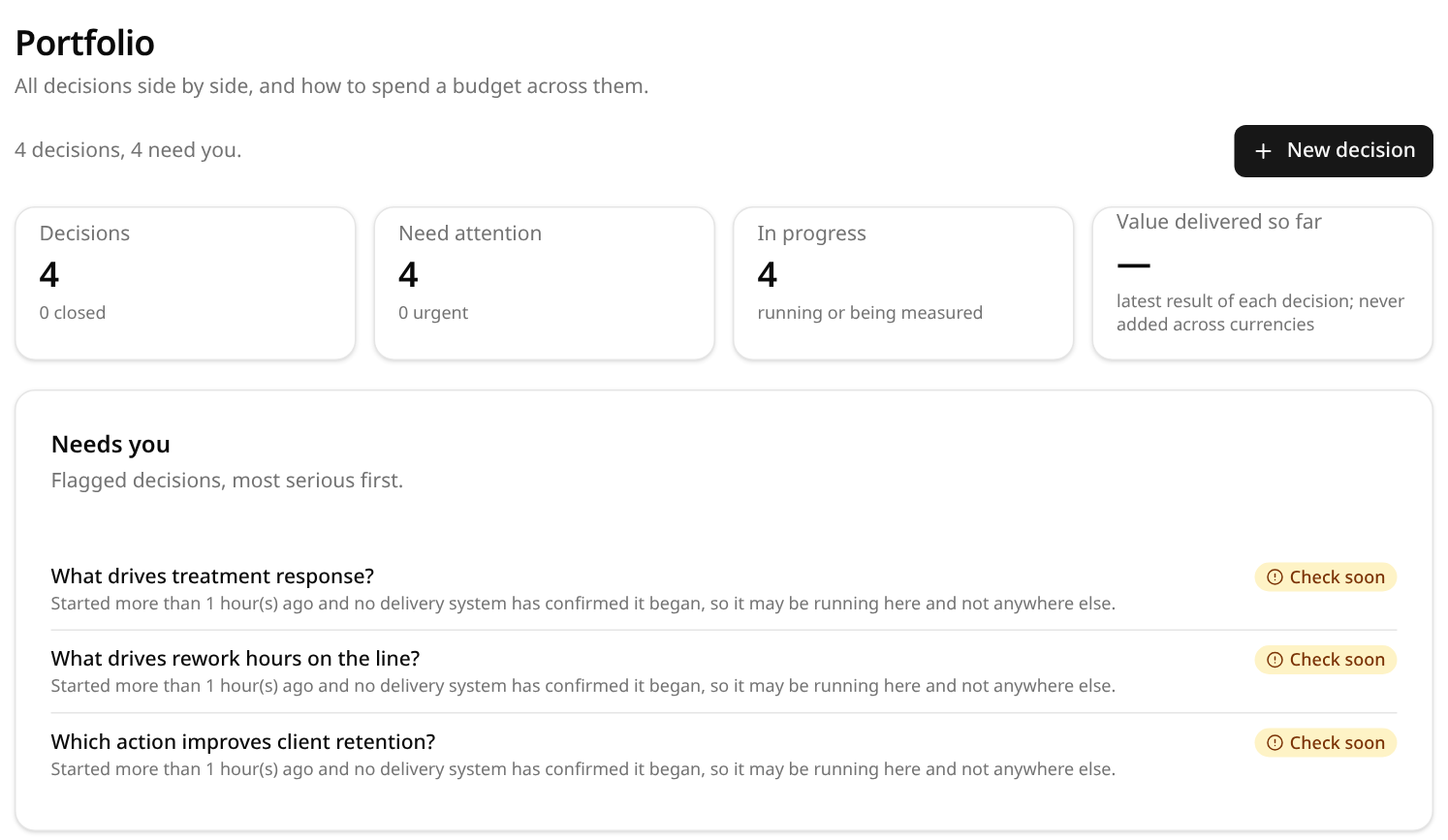
AnantCausal console · Portfolio
The portfolio page in the console: four decisions, all four needing attention and all four in progress, with no value delivered yet. Under Needs you, each flagged decision is listed with a Check soon badge and the reason, that it started more than an hour ago and no delivery system has confirmed it began.
Every flag states its reason, and a decision with nothing measured says so. Console screenshot, synthetic sample decisions.
Memo and notifications

Carry the reasoning to the people who decide.

A decision made in a console is invisible to everyone who does not log in.

Decision memo

The decision and who made it, the question, what the model says with its range and assumptions, what would change it, the safeguards, what happened, and a caveats block that is produced whether or not anyone asked. Print it as a page or a PDF, or send an expiring share link.

What this does not establish: A share link is a bearer secret, expires in 1 to 30 days, can be revoked, and serves a snapshot with no per-unit rows. The memo describes the model's evidence; it does not make the decision right.

Slack, Teams, email and signed webhooks

Events — a run started, halted, a stop rule breached, a metric source failing, a decision needing review — go to the channels you choose. Chat and email messages are worded in one place so they never disagree. Hold routine news during quiet hours or roll it into an hourly or daily digest; a halt or a breached stop rule is never held.

What this does not establish: Email goes only to members of the project, and only if your deployment has mail configured. Webhook deliveries are signed and retried, but retrying is at least once, so receivers should deduplicate.

Scheduled questions

Ask a question on a timer, with idempotent windows, a history of runs and the change since the last run. Backfill past windows and get the same rows live would have produced.

What this does not establish: The scheduled question is an effect question today; other question kinds are not scheduled.

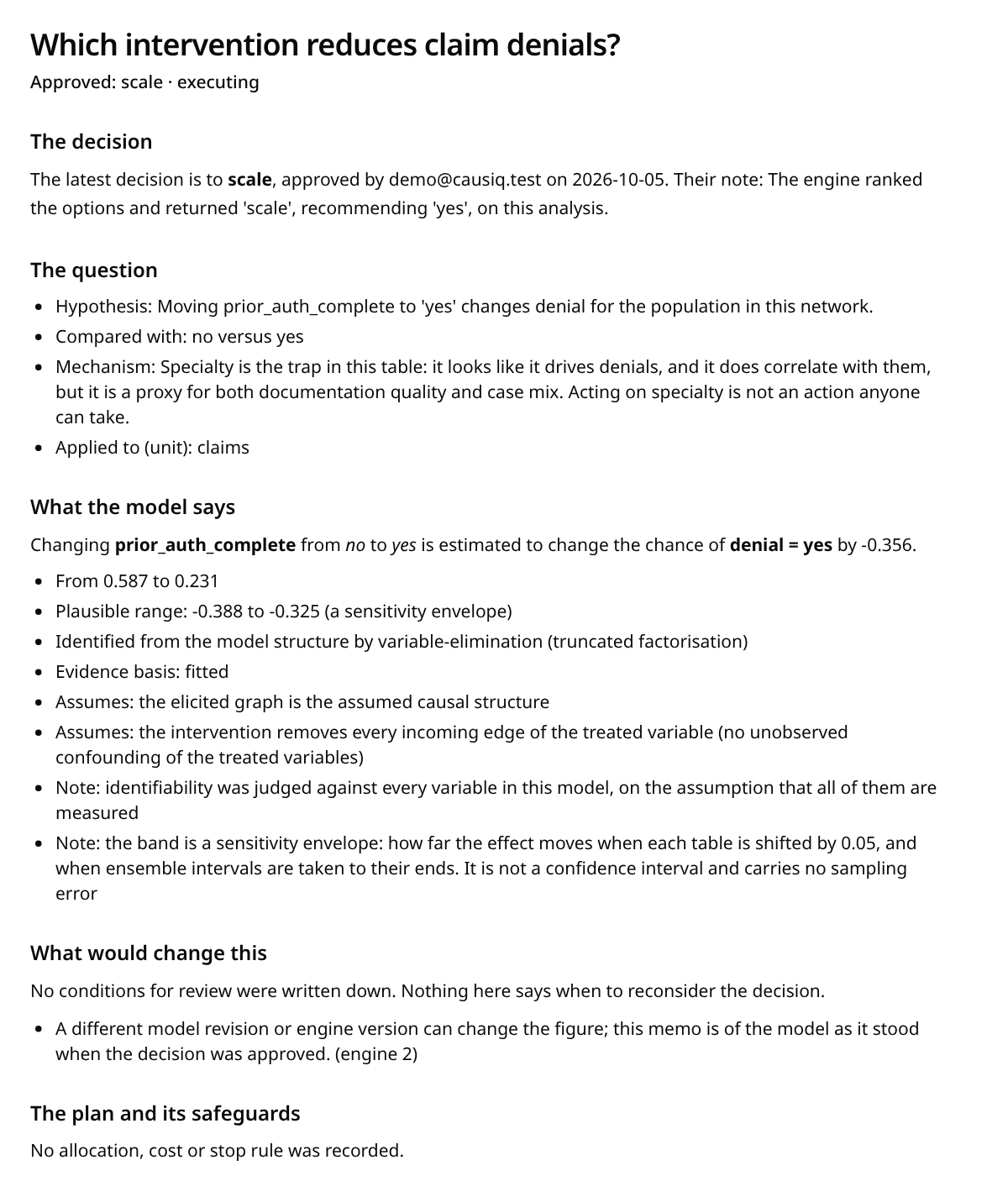
AnantCausal console · Decision memo
A decision memo in the console for a claim-denial decision: the decision and who approved it, the question with its hypothesis and the mechanism, what the model says (a change in denial of minus 0.356, from 0.587 to 0.231, with a plausible range and the assumptions it rests on), and what would change the decision.
A memo assembled from stored records by fixed rules. Console screenshot, synthetic sample decision.
Competing models

Separate what the model is unsure of from what people disagree about.

Two experts can draw different graphs, and the right response is to show what that does to the answer.

Compare models

Ask one effect question of two to ten models. The comparison keeps uncertainty within a model, which is its own band, apart from disagreement between models, which is the gap between their point effects. It says whether the answer depends on which structure you believe, whether the direction agrees, and which models disagree most.

What this does not establish: It is for effect questions. It does not say which model is right.

Clone to try a structure

Copy a chosen revision, with its provenance, into a new model that records where it came from and inherits none of the original's reviews or approvals.

What this does not establish: A clone starts unreviewed; it earns its own approvals.

A portfolio that cannot say why a decision is in trouble is a spreadsheet. This one says why, and says when it does not know.